
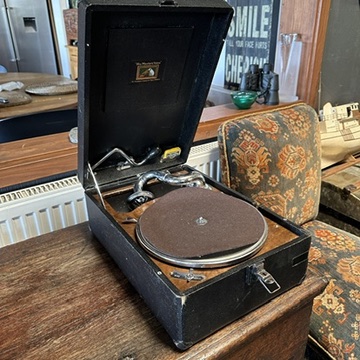
This Find Is Music To My Ears: His Masters Voice (HMV)1930s Gramophone
Every week there’s one item that makes me stop in my tracks. This week it was this wonderful HMV portable gramophone, discovered tucked away in a local second-hand shop here in Kungälv, Sweden.
There’s something magical about opening the lid of one of these machines. The folded tonearm, the rich wooden interior and that felt-covered turntable instantly transport you to another era, long before playlists and streaming.
This example appears to date from the 1930s or early 1940s, when HMV (His Master’s Voice) was one of the world’s leading names in recorded music. These portable gramophones allowed people to bring music into their homes, gardens and even on holiday, all powered by nothing more than a carefully wound spring motor.
What I particularly love is imagining the journey this one has taken. Built in Britain, it eventually found its way across the North Sea to Sweden, where decades later it quietly sat waiting for someone to appreciate it again.
Whether it needs a little restoration or simply a new owner who enjoys vintage technology, pieces like this remind me why I love treasure hunting. Every scratch and every worn corner hints at evenings spent listening to dance bands, jazz or perhaps a favourite classical record while the world outside looked very different.
Some finds are valuable because of what they’re worth.
Others are valuable because of the stories they still carry.
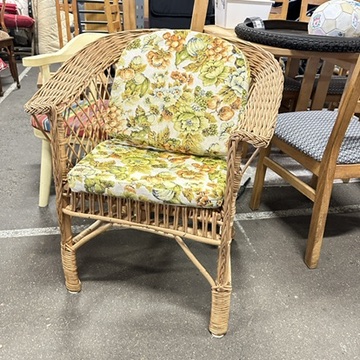
My Favourite Find: A 1970s Swedish Wicker Chair Full of Sunshine
Every now and then a piece comes along that makes you smile before you’ve even looked at the price.
This cheerful 1970s wicker armchair was one of those moments.
Found in a local second-hand shop in Kungälv, Sweden, it immediately stood out with its beautifully woven frame and wonderfully bold floral cushions. The warm honey-coloured wicker and unmistakably 1970s fabric capture an era when homes embraced natural materials, houseplants and vibrant patterns.
It’s the sort of chair that invites you to slow down. Perfect for a conservatory, reading corner or covered veranda, it brings a relaxed Scandinavian feel that’s as appealing today as it was fifty years ago.
One of the joys of vintage hunting is finding pieces that have survived decades without losing their personality. This chair has exactly that quality. It’s comfortable, full of character and ready for another chapter in someone’s home.
While many people walk past furniture like this, seeing only an old chair, I see craftsmanship, timeless design and a reminder that good furniture doesn’t have to be complicated to be beautiful.
Sometimes the best finds aren’t the rarest.
They’re simply the ones that make you imagine exactly where you’d put them.


Something Unexpected: A Clock That Saves Both Time and Money
At first glance, it looks like a handsome oak mantel clock. Look a little closer and you’ll discover its secret.
This ingenious Swedish Sparuret (Savings Clock) combined two everyday necessities into one elegant object: a working mechanical clock and a lockable savings bank. Produced by Aktiebolaget Sparuret during the early 20th century, it quietly encouraged a simple philosophy, keep an eye on the time, and keep adding to your savings.
The coin slot is discreetly set into the top of the solid oak case, while the rear houses the clock’s original adjustment mechanism. As the days passed and the clock faithfully marked each hour, spare coins gradually accumulated inside, turning the piece into both a household timekeeper and a gentle reminder of the value of saving.
Before online banking, banking apps, or even widespread home safes, objects like this helped families build good financial habits. Every dropped coin represented another small step towards a bicycle, a holiday, Christmas presents, or simply security for the future.
Today, the Sparuret is a wonderfully unexpected survivor of Swedish design. Practical, beautifully made, and delightfully inventive, it tells the story of an era when craftsmanship and everyday life were seamlessly woven together.
Sometimes the most interesting antiques aren’t just beautiful… they quietly reveal how people once lived.

A Piece of Swedish History: The Story Behind a Cast Iron Stove Door
Not every piece of history hangs on a museum wall.
Sometimes it sits quietly on the floor of a second-hand shop, covered in a century of honest rust.
This beautifully cast stove door bears the name Norrahammar No. 3, linking it to one of Sweden’s most respected industrial communities. Founded in the 1800s in Småland, Norrahammar became renowned for producing high-quality cast iron stoves, ranges and heating equipment that warmed Swedish homes for generations.
Long before central heating, the kitchen stove was the heart of the home. It provided warmth through harsh winters, cooked family meals and often heated water for washing. Every household depended on craftsmanship like this.
What makes this piece especially appealing is the quality of its casting. Even after decades of use, the raised lettering, decorative borders and original foundry markings remain beautifully defined. It was built to last, and it has.
Today, pieces like this are increasingly appreciated by collectors, restorers and interior designers. Some return to working life during the restoration of traditional Swedish homes, while others find a second career as striking decorative objects celebrating Sweden’s industrial past.
It’s easy to overlook a heavy piece of cast iron.
But behind the rust lies a story of Swedish engineering, skilled foundry workers, and countless winters spent gathered around a warm kitchen stove.

Hidden History: The Quiet Legacy of Birgit Krogh
Not every ceramic artist sought the spotlight. Some let their work speak for itself.
Birgit Krogh was one of Denmark’s quietly influential studio potters, creating beautifully hand-thrown stoneware that celebrated texture, form and the natural character of clay. Rather than relying on bold decoration, her work drew attention through deeply carved surfaces, earthy glazes and sculptural silhouettes that invited both touch and admiration.
Working during the golden age of Scandinavian studio pottery, Krogh embraced the movement’s philosophy that everyday objects could also be works of art. Each vessel was individually thrown and finished by hand, meaning no two pieces are ever exactly alike.
Today, her ceramics continue to be appreciated by collectors who value authentic craftsmanship and the timeless simplicity of Danish design. Pieces like this remind us that some of the most enduring Scandinavian artists built their reputations quietly, one beautifully made object at a time.
This week’s Hidden History celebrates the enduring appeal of Danish studio pottery and the remarkable craftsmanship of Birgit Krogh. ✨
Thank you for joining me on this week’s treasure hunt.
Every Friday, I’ll be sharing five new discoveries, unexpected stories, and forgotten pieces of history uncovered during my adventures through Sweden’s auctions, estate sales, and loppisar.
I hope you’ll visit again next Friday to see what treasures and stories I’ve uncovered.
Amanda.