

Catch of the Day : Vintage Wicker Fishing Basket
Not every treasure comes in glass or porcelain. Sometimes the most interesting finds are the ones that tell a quieter story.
This vintage wicker fishing basket was today’s favourite discovery, spotted by Henrik tucked away among a collection of overlooked items. At first glance it might seem simple, but the details reveal a life well lived. The tightly woven wicker has survived decades of use, while the original adjustable cotton shoulder strap and leather fastening remain wonderfully intact.
It’s easy to picture its original owner setting off before sunrise, the basket slung across a shoulder on the way to a favourite stretch of river or a quiet Swedish lake. Long before modern tackle bags and synthetic materials became the norm, baskets like this were the trusted companions of generations of anglers.
What I love most is that it needs absolutely nothing. No repairs. No restoration. Just a careful clean, a few photographs, and it’s ready for its next adventure. Pieces like this have already earned their patina honestly, and that’s something I never want to erase.
Whether it eventually hangs in a fishing lodge in Montana, a lakeside cabin in Canada, or a country home here in Scandinavia, it’s a reminder that the best vintage pieces aren’t just decorative. They were made to be used, and every mark is part of their story.
Sometimes the best catch of the day isn’t a fish at all. It’s finding the basket that once carried one.

My Favourite Find: 18th Century Swedish Bride’s Chest
Every now and then I come across a piece that immediately makes me stop and wonder about the life it has lived. This beautiful antique oak chest is one of those finds.
In Sweden, chests like this were traditionally known as brides’ chests. They were among a young woman’s most treasured possessions, filled with carefully woven linens, embroidered textiles, clothing, and keepsakes she had prepared for married life. More than simple storage, they represented hope, craftsmanship, and the beginning of a new chapter.
This particular example has all the character I love. The richly aged oak has developed a deep patina over centuries, while the hand-forged iron straps, original carrying handles, and elegant raised stand speak of exceptional craftsmanship. Across the front, the faded inscription and the date 1713 can still be made out, offering a tantalising glimpse into its long history.
Who was the bride? What family treasured it? How many homes has it quietly witnessed over the past three centuries?
Those are questions we’ll probably never answer, but they’re part of what makes pieces like this so captivating.
Today, this remarkable chest would make a stunning blanket box, coffee table, or statement storage piece, blending effortlessly into both traditional and contemporary interiors. Its purpose may have evolved, but its story continues.
This is exactly why I love searching for vintage treasures. Sometimes you don’t just find furniture. You find a piece of someone’s history, ready to become part of someone else’s.


Something Unexpected : Vintage Moulds for Casting Lead Soldiers
One of the joys of buying vintage is that every now and then you get an unexpected bonus.
While unpacking a recent purchase, I discovered something hidden away beneath the main items. Instead of finding a few forgotten odds and ends, I uncovered a complete vintage lead soldier casting kit.
Inside were original casting moulds, miniature cooking pots for melting lead, casting tools, and even a selection of finished lead soldiers. It was like opening a time capsule from an era when making your own toy soldiers was a popular hobby.
Before plastic toys became commonplace, enthusiasts would melt lead and carefully pour it into moulds to create miniature armies, painting each figure by hand. It was a pastime that combined craftsmanship, patience, and imagination, producing unique collections that were proudly displayed or used in tabletop battles.
Finding the entire kit together is a rare treat. It tells the story not only of the finished figures but of the person who spent countless hours creating them, one soldier at a time.
Moments like this are one of the reasons I love treasure hunting. You never know when an ordinary purchase will reveal an extraordinary glimpse into someone’s forgotten hobby.

A Piece of Swedish History: The Levin Guitar That Helped Shape Swedish Music
For much of the 20th century, if you learned to play the guitar in Sweden, there was a good chance it was a Levin.
Founded in 1900 by master luthier Herman Carlson Levin in Gothenburg, Levin quickly established itself as Sweden’s most respected guitar manufacturer. Combining traditional craftsmanship with innovative production techniques, the company earned an international reputation for building instruments that were both beautifully made and remarkably reliable.
By the 1950s and 1960s, Levin guitars could be found in homes, schools, churches, dance bands, and music clubs across Sweden. Their elegant archtop models, with graceful f-shaped sound holes, floating bridges, and distinctive curved bodies, were particularly popular with jazz musicians while also becoming treasured family instruments for everyday music-making.
Levin’s reputation eventually spread far beyond Sweden’s borders. During the 1970s, many of its guitars were exported internationally under the Goya name, introducing Swedish craftsmanship to musicians around the world. Today, vintage Levin guitars are highly regarded by collectors and players alike for their superb build quality, warm tone, and enduring character.
Looking at this guitar, it’s easy to imagine the songs it once accompanied. Family gatherings, local dances, singalongs, and countless hours of practice have all left their mark, not just on the wood, but on the instrument’s story.
More than a vintage guitar, a Levin is a piece of Sweden’s musical heritage, carrying over a century of craftsmanship and tradition in every note.
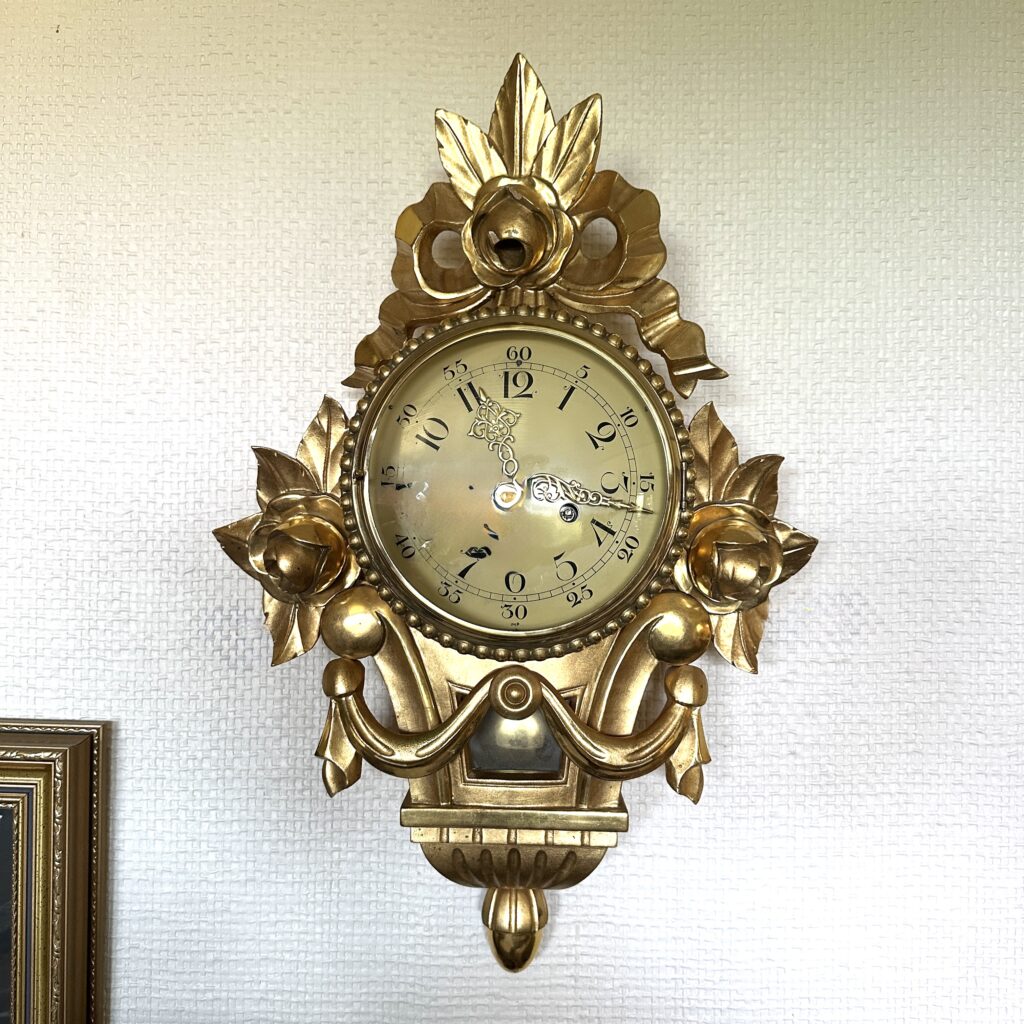
Hidden History: A clock with practical elegance
At first glance, this beautiful gilded Swedish wall clock is all about decoration. Delicately carved roses, flowing ribbons and graceful curves give it an unmistakable air of elegance. But hidden within its ornate design is a feature born not of fashion, but of practicality.
Look closely at the dial.
Rather than showing only the hours, the clock also carries an outer ring marked in five-minute intervals from 5 to 60. Today we barely notice such details, but in the late 19th and early 20th centuries this made telling the time much quicker. A glance at the minute hand was enough to judge the time accurately without mentally dividing the spaces between the hour markers.
It was a small innovation that reflected everyday life. Railway timetables, factory shifts, school hours and appointments were becoming increasingly important. Timekeeping was no longer simply about knowing the hour. It was about knowing the minute.
The clock itself balances beauty with function. Richly ornamented in the Gustavian tradition, its carved roses soften what is essentially a precision instrument. It reminds us that practical household objects were once expected to be beautiful as well.
That philosophy is something I admire in Scandinavian design. Even when an object had a purely functional purpose, craftsmanship and decoration were rarely considered unnecessary luxuries. They were simply part of making something worth living with.
More than a century later, this clock still does exactly what it was designed to do. It quietly marks the passing of time while reminding us that practical objects can also be works of art.
Perhaps that’s the real hidden history.
Sometimes the most interesting feature isn’t the carving or the gilding.
It’s the thoughtful little detail that helped a family keep time every single day.
Thank you for joining me on this week’s treasure hunt.
Every Friday, I’ll be sharing five new discoveries, unexpected stories, and forgotten pieces of history uncovered during my adventures through Sweden’s auctions, estate sales, and loppisar.
I hope you’ll visit again next Friday to see what treasures and stories I’ve uncovered.
Amanda.