

The Treasure Hidden Among the Toys: Vintage Hindsgaul Mannequin Head, Denmark
This find made me smile before I even picked it up. Not because of what it was, but because of where it was hiding.
Tucked away in the children’s section of a local charity loppis, surrounded by toys and games, was this beautifully sculpted Hindsgaul mannequin head from Denmark. I suspect most shoppers simply saw an old shop display and carried on. But Hindsgaul wasn’t just another manufacturer. Their display forms became a familiar sight in fashion stores across Europe during the mid-20th century, admired for their elegant proportions and remarkably lifelike expressions.
What caught my eye wasn’t simply the original Hindsgaul label still attached to the base. It was the quiet personality of the piece. The softly modelled face, gentle smile, and carefully sculpted hair give it a warmth that modern display heads rarely capture.
Originally created to display hats and fashion accessories, these mannequin heads have found a second life as decorative objects in their own right. Whether displayed on a shelf, holding a favourite vintage hat, or used as a studio prop, they bring a little piece of classic Scandinavian design into a home.
It’s a lovely reminder that treasures don’t always sit in the antiques cabinet. Sometimes they’re waiting quietly between the children’s books and old board games, hoping someone recognises them for what they really are.ndinavian glass would still have been waiting for someone else to discover it.
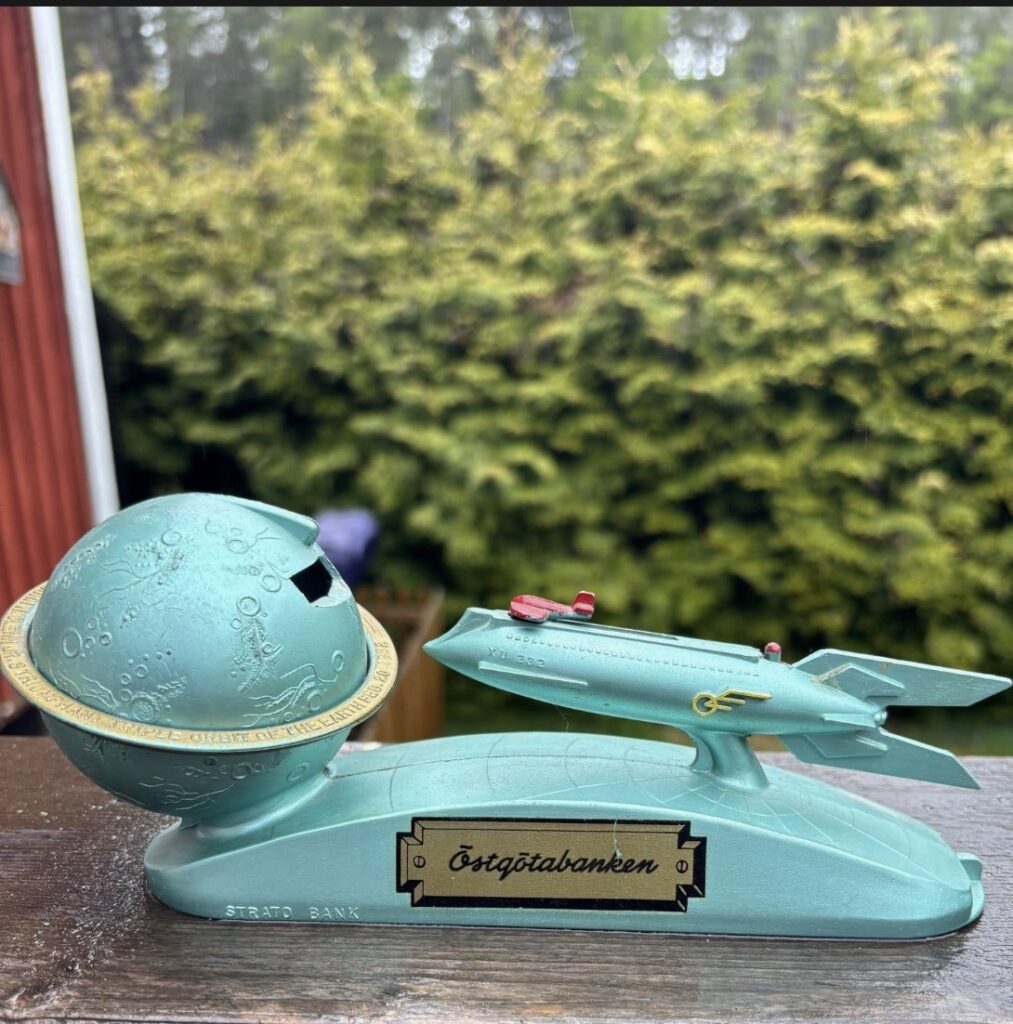
My Favourite Find: Strato Bank Space Age Savings Bank, Sweden
Every week there’s usually one item that I simply can’t stop thinking about. This little Space Age savings bank was that piece.
Hidden among more conventional antiques was this wonderfully futuristic Strato Bank, originally produced as a promotional savings bank for Östgötabanken during the excitement of the Space Age. With its streamlined rocket, orbiting globe and atomic-age styling, it captures the optimism of an era when the future seemed just around the corner.
Banks once encouraged children to save by giving away imaginative money boxes like this, turning the simple act of putting away a few coins into an adventure. Rather than castles or piggy banks, this one invited young savers to imagine rockets, satellites and journeys beyond Earth. It’s a delightful snapshot of the 1950s and 1960s, when space exploration influenced everything from architecture and furniture to toys and everyday household objects.
What I love most is that this piece still has its original character, complete with the bank’s name proudly displayed on the front. It isn’t just a quirky savings bank. It’s a small piece of design history from a time when even promotional gifts were thoughtfully made and full of imagination.
This was my favourite discovery of the week because it reminds me that the best finds are often the most unexpected. Sometimes it’s the unusual objects, quietly waiting on a shelf, that tell the most fascinating stories and bring the biggest smile when you finally bring them home.


Something Unexpected : Scan-Globe Weather Station, Denmark
At first glance, it looked like an ordinary classroom globe. But the closer I looked, the more intriguing it became.
Mounted beneath the globe is a handsome wooden base housing three precision weather instruments: a barometer, thermometer and hygrometer. Together they transform an everyday globe into a fascinating desktop weather station, blending education, science and Scandinavian design in one elegant object.
Produced by Scan-Globe of Denmark, pieces like this became popular during the mid-century years, when curiosity about the wider world and advances in science found their way into homes, schools and offices. Rather than hiding the instruments away, the designers celebrated them, creating an object that was as decorative as it was practical.
It’s the sort of piece that encourages conversation. One moment you’re tracing a journey across the Pacific, the next you’re checking the air pressure before heading outdoors. That combination of craftsmanship, function and quiet ingenuity is something I always enjoy discovering.
This was one of those finds that reminded me why I love searching through antiques. Sometimes the most memorable objects aren’t the rarest or the most valuable. They’re the ones that make you stop, take a second look, and wonder about the stories they have quietly witnessed over the decades.


A Piece of Swedish History: The Ericofon, Sweden’s “Cobra Telephone”
Sometimes an object tells the story of an entire generation. These colourful Ericofon telephones, affectionately known as the Cobra Phone because of their distinctive shape, did exactly that.
Designed by Ericsson during the 1950s, the Ericofon broke almost every convention of the traditional telephone. Instead of a separate handset and base, everything was combined into one elegant sculptural form. Dialling and talking became one seamless movement, making it one of the most recognisable industrial designs of the twentieth century.
Produced in a wonderful range of colours, from soft greens and creams to pastel yellows and greys, these telephones perfectly captured the optimism of post-war Scandinavian design. Functional, playful and beautifully simple, they quickly became symbols of the modern Swedish home and were exported around the world.
Finding not just one, but an entire shelf filled with them was a wonderful surprise. Each one carries the marks of a life once lived, a reminder of countless family conversations, birthday calls and everyday moments that passed through these receivers long before mobile phones transformed how we communicate.
Today, the Ericofon is celebrated as an icon of Swedish industrial design. It reminds us that everyday objects can become timeless classics when thoughtful engineering meets beautiful design. Discoveries like this are exactly why I never know what might be waiting around the next corner at a Swedish loppis.d and felt during a remarkable period of design history.


Hidden History: The Taeping Clipper and a Journey from Scotland to Sweden
Every so often I find an object that sends me down a research rabbit hole. This remarkable half-hull model of the famous clipper ship Taeping was one of those discoveries.
I found it at a local estate sale near Lyckorna, a historic seaside resort on Sweden’s Bohuslän coast. At first, it was simply an impressive handcrafted maritime display. But the more I looked, the more intriguing its story became.
Mounted on the wooden backboard is a brass plaque engraved “Messrs. Wood & Co. 1876,” while the elegant hull pays tribute to the legendary Taeping, one of the fastest tea clippers ever built. Constructed in 1863 by Robert Steele & Co. in Greenock, Scotland, the Taeping secured its place in maritime history by winning the famous Great Tea Race of 1866, reaching London just 28 minutes ahead of its nearest rival after a voyage of more than 14,000 nautical miles.
What fascinated me most was where I found it.
Lyckorna itself has a surprising Scottish connection through Andrew Macfie, a businessman from Greenock who settled on this stretch of the Swedish coast in the mid-19th century and helped establish the seaside resort. Given the close-knit world of Scottish merchants and shipbuilders during that period, it’s tempting to wonder whether the people behind this model moved within the same industrial and social circles as the builders of the Taeping.
I’ll probably never know the complete story, and perhaps that’s part of the appeal. Antique objects often leave us with clues rather than answers. This model isn’t simply a beautiful piece of maritime décor. It’s a reminder that history has a remarkable habit of travelling. Somehow, over more than a century, a tribute to one of Scotland’s greatest clipper ships found its way to Sweden’s west coast… where it was quietly waiting for someone curious enough to ask, “How did you get here?”
Thank you for joining me on this week’s treasure hunt.
Every Friday, I’ll be sharing five new discoveries, unexpected stories, and forgotten pieces of history uncovered during my adventures through Sweden’s auctions, estate sales, and loppisar.
I hope you’ll visit again next Friday to see what treasures and stories I’ve uncovered.
Amanda.