
Made to Be Worn: Wonderfully Hand-Carved Wooden Clogs
Sometimes I pick something up because I recognise the maker. Sometimes because I know exactly what it is.
And sometimes I pick something up because the workmanship makes it impossible to leave behind.
These wooden clogs were one of those finds.
At first glance they’re simply a pair of traditional wooden shoes, but look more closely and almost every available surface has been carved. Geometric borders, tiny triangles, diamond patterns and radiating lines have all been cut carefully into the wood, turning something essentially practical into a piece of folk art.
What I particularly love is that they aren’t perfectly identical. The carver has repeated the same overall design across both shoes, but small differences remain. That’s the human hand showing through.
Pieces like these are fascinating because wooden footwear was once an ordinary part of working life across many parts of Europe. Wood was inexpensive, durable and practical, but people still found ways to decorate everyday possessions. Something didn’t have to be precious to deserve craftsmanship.
Exactly where this pair originated is something I still want to investigate. The carving may give us clues, and that’s part of the pleasure of finding something unfamiliar.
For now, though, they came home with me for a much simpler reason.
Someone took an everyday object and spent an extraordinary amount of time making it beautiful.
Those are very difficult things for me to leave behind.

My Favourite Find: A Sculptural Relief by Axel Einar Lindskög
Every treasure-hunting trip seems to produce one piece that stops me in my tracks.
This was mine.
I spotted this large plaster relief leaning amongst an assortment of other things and immediately knew I wanted a closer look. A kneeling female figure emerges from the surface in wonderfully soft sculptural form, contrasted by the almost graphic treatment of her hair, hands and face.
It has a distinctly interwar feeling to it, somewhere between sculpture and decorative art. Light is particularly important to the piece. As it moves across the raised surface, different parts of the figure appear more strongly while others seem to disappear back into the plaster.
Then came the detail that made things even more interesting: the signature A E Lindskog.
Research led me to Swedish sculptor Axel Einar Lindskog. Other signed works by Lindskog have appeared at Swedish auction, including plaster sculptures and remarkably similar reliefs depicting female figures. One documented example measures approximately 76 × 48 cm, while another, catalogued under his full name, measures around 72 × 42.5 cm.
His work also appears in decorative lighting. A documented sculpted plaster table lamp attributed to A E Lindskog and dated to the 1930s uses figurative decoration, giving another glimpse of an artist working where sculpture, interiors and design met during Sweden’s interwar period.
There are also signed freestanding plaster female figures by Lindskog in Swedish auction records, reinforcing that the female form was a recurring subject in his surviving work.
And that makes this find rather more exciting.
I didn’t recognise Lindskog’s name when I first saw the relief. I recognised the work.
The scale, composition and beautifully stylised figure were enough to make me pull it out and turn it over. Only afterwards did the signature begin to reveal the history behind it.
That’s one of the things I love most about treasure hunting. Knowledge certainly helps, but occasionally you have to trust your eye first and research the name later.
This time, my eye was right.


Something Unexpected: When Everyday IKEA Becomes Vintage
Not every treasure-hunting find is old, rare or beautifully handmade.
Sometimes it’s bright red plastic.
I found this folding IKEA bed tray and initially liked it for exactly what it is: wonderfully practical Scandinavian design with a generous tray, folding wire legs and those very useful little recessed cup holders.
Then came the slightly strange realisation.
IKEA itself is becoming vintage.
For many of us, IKEA doesn’t immediately register as something to collect. It is simply part of everyday life. Furniture we bought for a first home, shelves we assembled with varying degrees of enthusiasm, kitchen pieces we’ve owned for so long that we’ve stopped noticing them.
But those everyday objects are quietly ageing.
Earlier IKEA pieces increasingly capture the colours, materials and ideas of the period in which they were designed. Bold plastics, simple metal structures and clever space-saving solutions can now look unmistakably retro, particularly when compared with what IKEA sells today.
And this little red tray is a perfect example.
Its folding legs allow it to disappear almost flat when it isn’t needed, while the moulded top incorporates two cup holders and a raised edge. The idea hasn’t disappeared either. IKEA still sells folding bed trays today, describing the same basic virtues: lightweight construction, folding legs and practical spaces for cups, books and tablets.That’s what makes objects like this interesting.
Good everyday design often doesn’t announce itself as important. It simply works, gets used, gets put away, comes out again and gradually becomes part of people’s lives.
Then one day, without anybody really noticing when it happened, it becomes vintage.
So yes, amongst the studio pottery, hand-carved folk art, Swedish glass and mysterious signed sculptures, I brought home a red plastic IKEA bed tray.
Because sometimes the history of design isn’t sitting in a museum. Sometimes it’s having breakfast in bed.

A Piece of Swedish History: Gunnel Sahlin Leaf Platter for Kosta Boda
Some names appear again and again when you’re treasure hunting in Sweden, and Gunnel Sahlin is one I’m always pleased to find.
This wonderful turquoise glass dish is a perfect example of why.
Its large organic form is covered with concentric ripples that sweep and distort around the centre, creating an almost hypnotic optical effect. Depending on the angle and the light, those lines seem to move across the glass.
But there is much more behind it than simply a beautiful object.
Born in Umeå in 1954, Gunnel Sahlin originally trained in textiles at Konstfack rather than glass. After graduating she worked in New York for Katja of Sweden, developing the strong understanding of colour and pattern that would later become such an important part of her glassmaking.
In 1986 she was recruited by Kosta Boda, where she brought something very different to traditional Swedish glass. Her playful approach to colour and form helped give the company a younger, more contemporary identity, and during the 1990s she became one of the designers associated with the international recognition of modern Swedish design.
Nature has also been a recurring source of inspiration throughout her career, from plants and flowers to fruit and organic forms. Her wonderfully colourful Frutteria glass fruits became one of her best-known commercial successes.
Sahlin later became Professor of Glass and Ceramics at Konstfack from 1999 to 2004, and her work today can be found in museum collections including Sweden’s Nationalmuseum and Röhsska Museum.
And perhaps that’s why I enjoy finding pieces like this.
It isn’t simply another piece of vintage Kosta Boda glass. It’s a small part of a period when Swedish designers were experimenting with colour, material and form and attracting attention far beyond Sweden.
Sometimes you bring home a beautiful piece of glass. Sometimes you bring home a little piece of Swedish design history.
Hidden History: The Owl That Helped Reinvent Nittsjö
Some vintage pieces are instantly recognisable because of a famous name. Others simply make you smile.
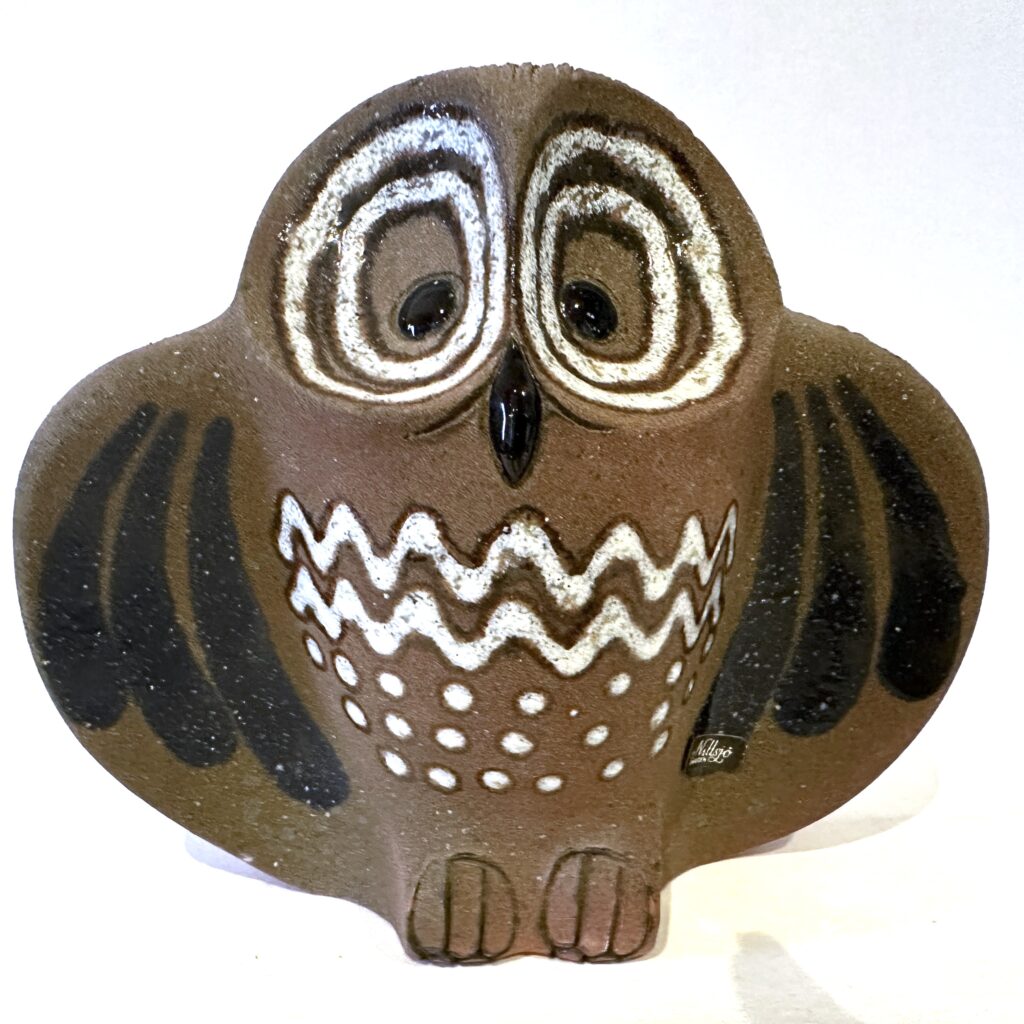
This wonderfully wide-eyed ceramic owl by Thomas Hellström managed to do both.
Hellström was born in 1924 in the United States, grew up in Gothenburg and studied art and design in Gothenburg and Stockholm before settling in Rättvik. In 1958 he joined Nittsjö Keramik as a designer and technician.
And his arrival came at an interesting moment in the company’s history.
Nittsjö’s roots stretch all the way back to 1843, when the business began as a brickworks. Pottery production followed in 1847, beginning a ceramic tradition that would continue for generations. By the 1950s, however, the company had experienced a downturn and needed fresh ideas.
Then came Thomas Hellström.
Nittsjö’s own history rather wonderfully describes him as an “idéspruta utan gräns”, essentially an inexhaustible fountain of ideas. His knowledge of ceramics and production helped give Nittsjö a new identity, and he went on to create everything from functional wares to sculpture.
Animals became an especially recognisable part of his work: foxes, bears, deer, birds and, of course, owls. This particular owl belongs to a family of stylised Nittsjö owl designs associated with Hellström in the 1960s, with their broad forms, enormous expressive eyes and wonderfully graphic decoration.
There was a serious artist behind those cheerful creatures too. Hellström worked in painting, sculpture and graphic art, undertook public commissions for schools, churches and banks, and his work entered collections including Nationalmuseum and Röhsska Museum.
That’s the hidden history I love discovering.
At first he’s simply a rather fabulous brown owl staring back at you from a shelf.
Then you turn him over, investigate the name and discover that he’s connected to one of Sweden’s oldest ceramic manufacturers and to a designer who helped give that company a new direction during the mid-century period.
Never underestimate an owl with very big eyes. 🦉
Thank you for joining me on this week’s treasure hunt.
Every Friday, I’ll be sharing five new discoveries, unexpected stories, and forgotten pieces of history uncovered during my adventures through Sweden’s auctions, estate sales, and loppisar.
I hope you’ll visit again next Friday to see what treasures and stories I’ve uncovered.
Amanda.