Sometimes Pottery Finds You: An Unusual German Art Vase
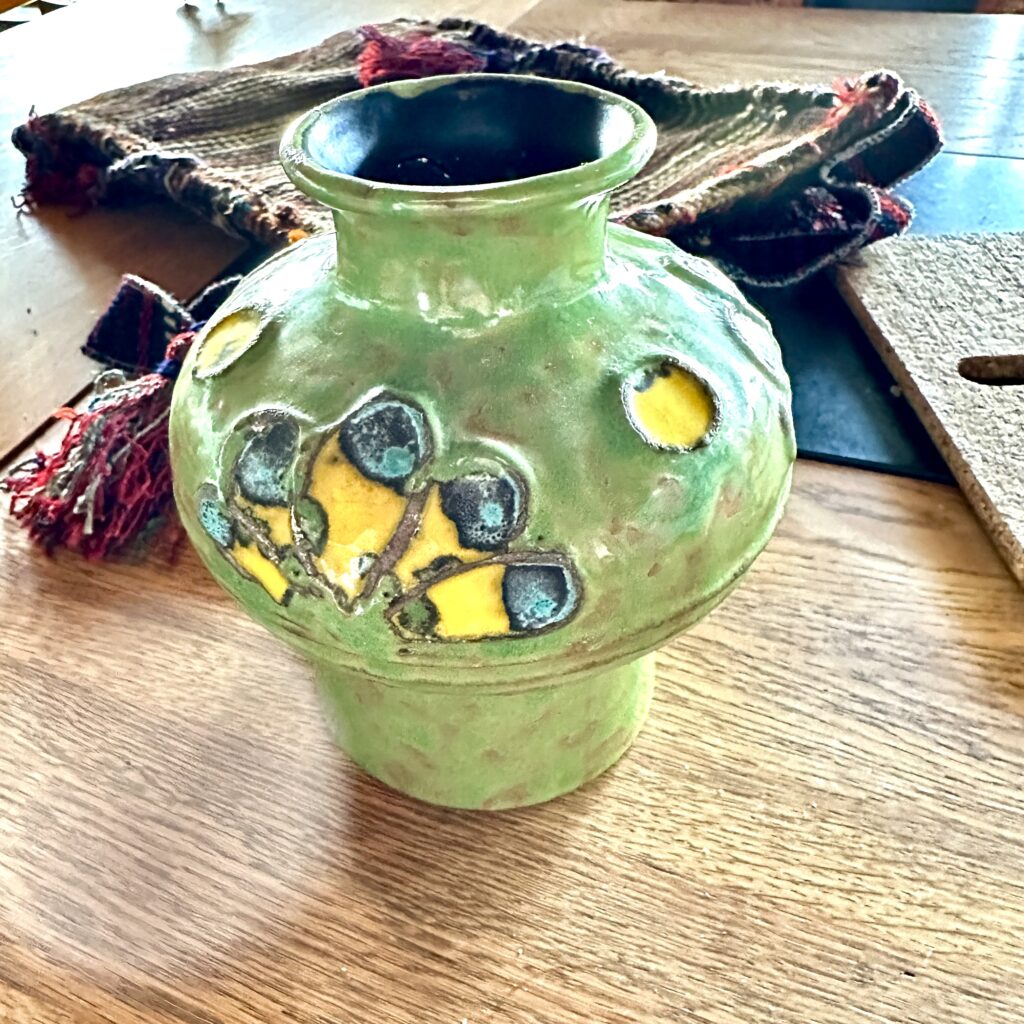
I come across a lot of vintage German pottery, so it takes something a little different to catch my eye. This one did.
It was the colour first. The soft mossy green glaze is unusual enough, but then there are those wonderful bursts of yellow, turquoise and dark brown across the surface. They look almost like abstract flowers or seed pods, and the decoration has a wonderfully handmade, experimental quality to it.
The shape caught me too. That wide rounded body, raised neck and substantial foot give it a strong sculptural presence. Turn it around and the glaze changes, with little variations and irregularities that make it feel very different from something mass produced to be perfectly uniform.
I didn’t know who made it when I picked it up. I simply knew it was worth turning over and investigating.
And that’s one of my favourite rules when treasure hunting: you don’t always need to recognise the name on the bottom. Sometimes the object itself tells you to take a closer look.
This one came home with me, and now the detective work begins.
My Favourite Find: An Antique Handwoven Nomadic Salt Bag
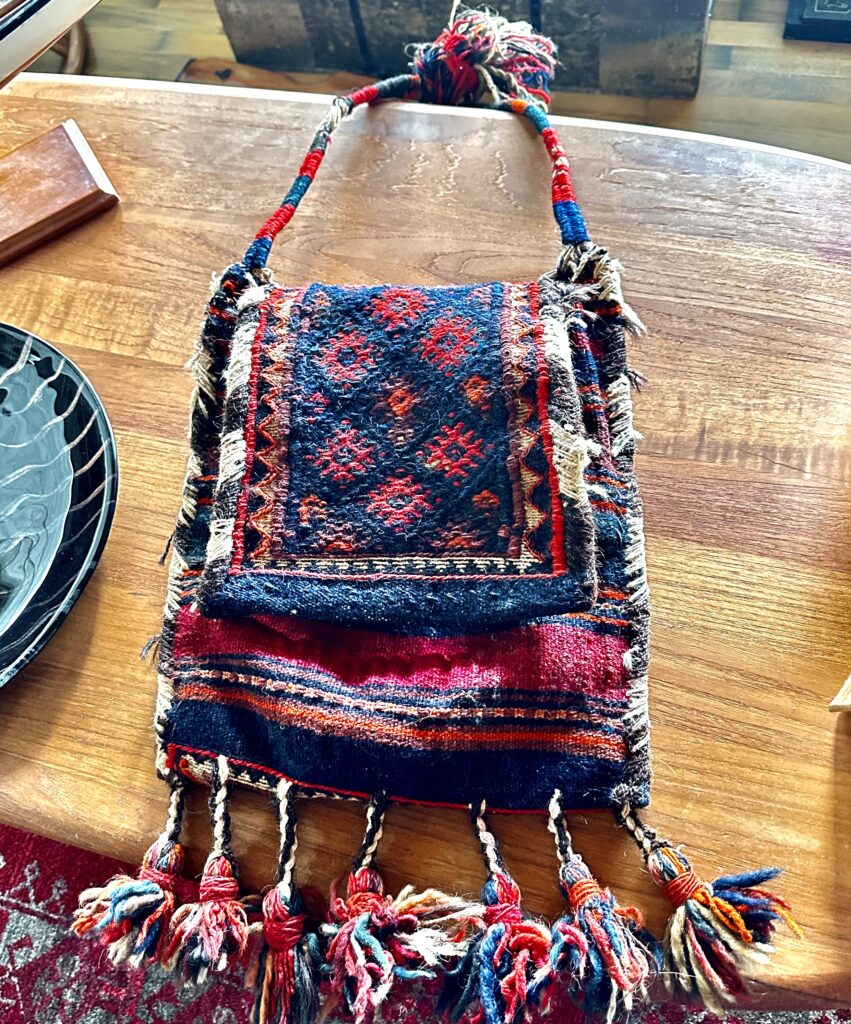
This was my favourite find of the week, and at first glance it would be very easy to mistake it for an old shoulder bag.
These woven bags were traditionally made by nomadic and tribal communities for carrying and storing salt, an essential commodity for both people and livestock. Today they are increasingly collected as pieces of textile and folk art, with the weaving, patterns and construction telling part of the story of the people who made them.
What caught my eye was the colour and texture. Deep blue, red and warm earthy tones run through the heavily woven surface, while the long tassels and wrapped carrying strap give it wonderful movement. It has age, wear and irregularity, but that’s exactly what I want to see in a piece like this.
The exciting thing about finds like this is that they can be very easy to underestimate. Sitting among old bags in a secondhand shop, it could simply look like a rather worn handmade bag. The exciting thing about finds like this is how easy they are to overlook. I liked it enough to bring it home, and it was only afterwards that I discovered what it actually was, and how collectible some of these old salt bags have become.
I paid very little for this one, which made the discovery afterwards even more satisfying. Now comes the interesting part: researching its exact origin and age.
Something Unexpected: A Giant Vintage Swedish Flag
It’s surprising what you can find when you’re not really looking for anything in particular.
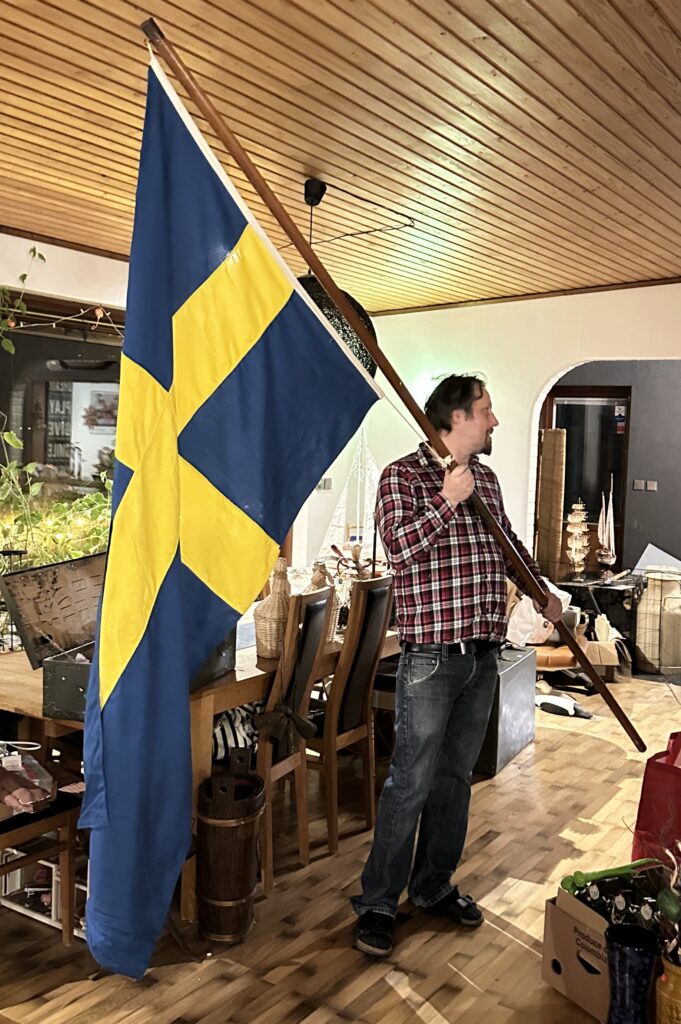
This enormous Swedish flag certainly wasn’t on my shopping list. Folded up, it was difficult to appreciate quite how large it actually was. It was only when we got it home and opened it properly that the scale became apparent. Henrik provides some useful perspective here!
From its construction and appearance, I believe the flag dates from around the mid-20th century, and its extraordinary size suggests it may originally have flown from a substantial public or civic building. A town hall, church, school or similar municipal building would all be possibilities. Without knowing its history we can’t say exactly where it came from, but it certainly doesn’t feel like the sort of flag that once hung from someone’s front porch.
The long wooden pole is a wonderful survivor in its own right. Together they give you some idea of just how imposing the flag must have looked when it was actually flying.
There is something rather wonderful about finding an object like this because it makes you immediately curious about its past. Where did it hang? What events did it witness? And how did something this enormous eventually find its way into a secondhand shop?
Old flags can be fascinating pieces of social history. Look beyond national flags and you can find vintage maritime flags, company flags, military and civic examples, advertising pennants and regional designs. Age, construction and provenance can turn what initially looks like an ordinary piece of fabric into something considerably more interesting.
What to look for: sewn construction rather than a modern printed design, quality fabric, older ropes and fittings, substantial wooden poles, unusual sizes and any markings or clues that might reveal where a flag was originally used.
And sometimes the most important thing to check before buying is simply:
Will it fit in the car? 😂🇸🇪
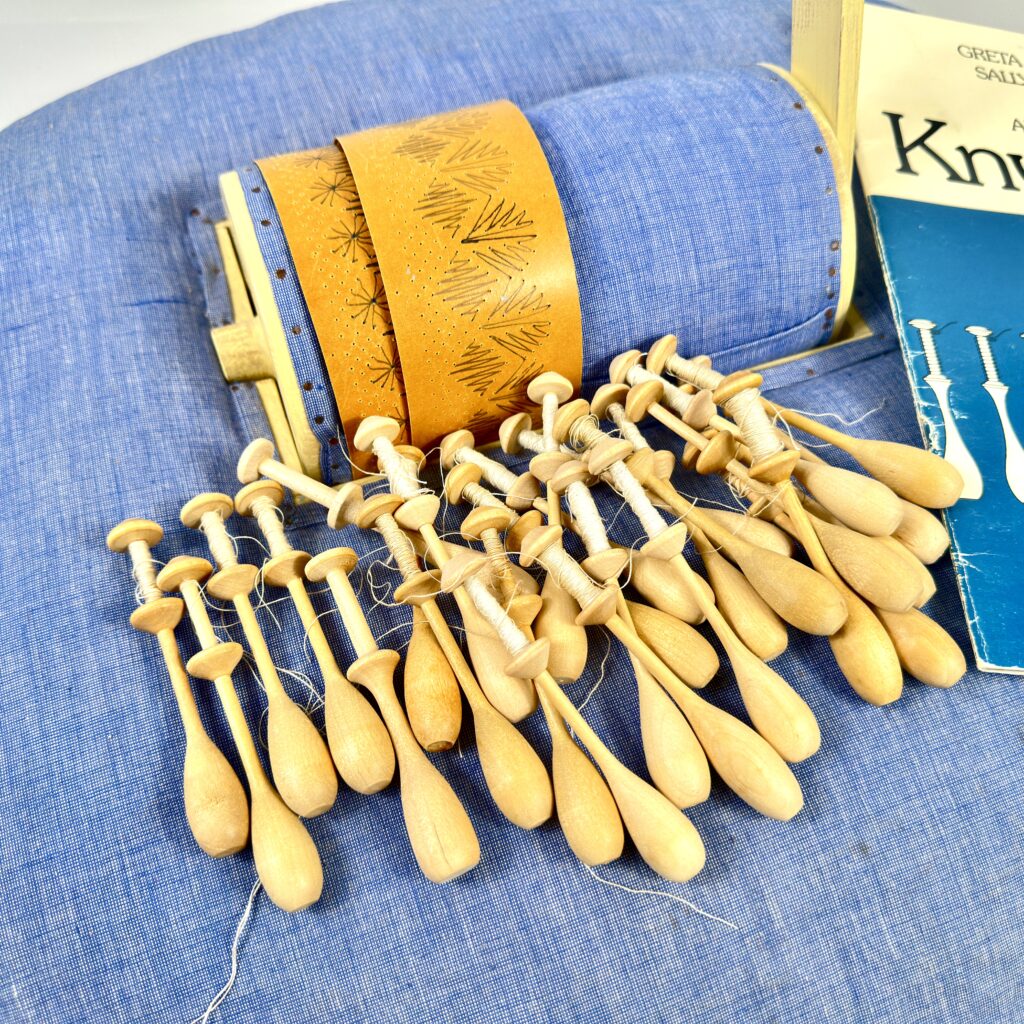
A Piece of Swedish History: The Traditional Art of Swedish Bobbin Lace
Some finds are interesting because they’re beautiful. Others are interesting because they preserve a little piece of everyday history.
This wonderful old Swedish lace-making pillow, complete with its wooden bobbins and tools, does both.
Bobbin lace, or knyppling in Swedish, has a particularly strong tradition in Sweden. Vadstena became the country’s best-known centre for the craft, with documented lacemaking there going back several centuries. By the 1800s, making lace had become an important source of income for people in and around the town, particularly women working from home.
What I love about finding something like this is that it isn’t simply an antique object to put on a shelf. This was a working tool. Imagine all those little wooden bobbins moving backwards and forwards, each carrying its thread while an intricate piece of lace slowly appeared across the pillow.
The arrival of cheaper machine-made lace during the 19th century threatened the traditional craft, but Sweden made a concerted effort to preserve it. A lace-making school was established in Vadstena in 1903, and the town remains closely associated with Swedish bobbin lace today.
I’ve had a fascination with these old lace pillows for years, and a couple of years ago I made a video showing one and how this extraordinary craft works. If you’ve never seen bobbin lace being made, it’s worth watching. What initially looks like a bewildering forest of bobbins suddenly begins to make sense.
Watch my Swedish bobbin lace video on YouTube
What to look for: old wooden bobbins, traditional padded pillows, rollers, pricked patterns, handmade tools and, best of all, examples that have survived with their bobbins, thread and accessories still together.
There is something rather special about finding an old craft set that looks as though the maker has simply put down her bobbins and walked away. 🧵

Hidden History: Three Nordic Kings, One Truce and a Swedish Pottery Dish
At first glance, this is simply a wonderfully quirky piece of 1970s Swedish studio pottery. Three rather stern-looking crowned men stare out from the surface, surrounded by deeply worked geometric decoration in earthy brown, black, green and ochre glazes.
But when I discovered that the dish came from Kungälv, those three faces suddenly became much more interesting.
In 1101, three Scandinavian kings are said to have met at the old settlement of Kungahälla, present-day Kungälv. They were Inge the Elder of Sweden, Magnus Barefoot of Norway and Erik Ejegod of Denmark, and they came together to negotiate peace after years of conflict.
Kungahälla was an important medieval settlement, strategically positioned close to the borders of the three Scandinavian kingdoms. At the time it belonged to Norway, and its location made it a natural meeting point when the rulers of Sweden, Norway and Denmark needed to settle their differences.
Look again at the dish and those three crowned figures begin to make sense.
I can’t prove that the unknown potter intended this to represent the Trekungamötet, but given the Kungälv connection and the three kings depicted together, it certainly seems a strong possibility.
And that’s what makes pieces like this so much fun to find. Something that initially looks like an unusual piece of vintage pottery can lead you back more than 900 years into Scandinavian history.
Thank you for joining me on this week’s treasure hunt.
Every Friday, I’ll be sharing five new discoveries, unexpected stories, and forgotten pieces of history uncovered during my adventures through Sweden’s auctions, estate sales, and loppisar.
I hope you’ll visit again next Friday to see what treasures and stories I’ve uncovered.
Amanda.