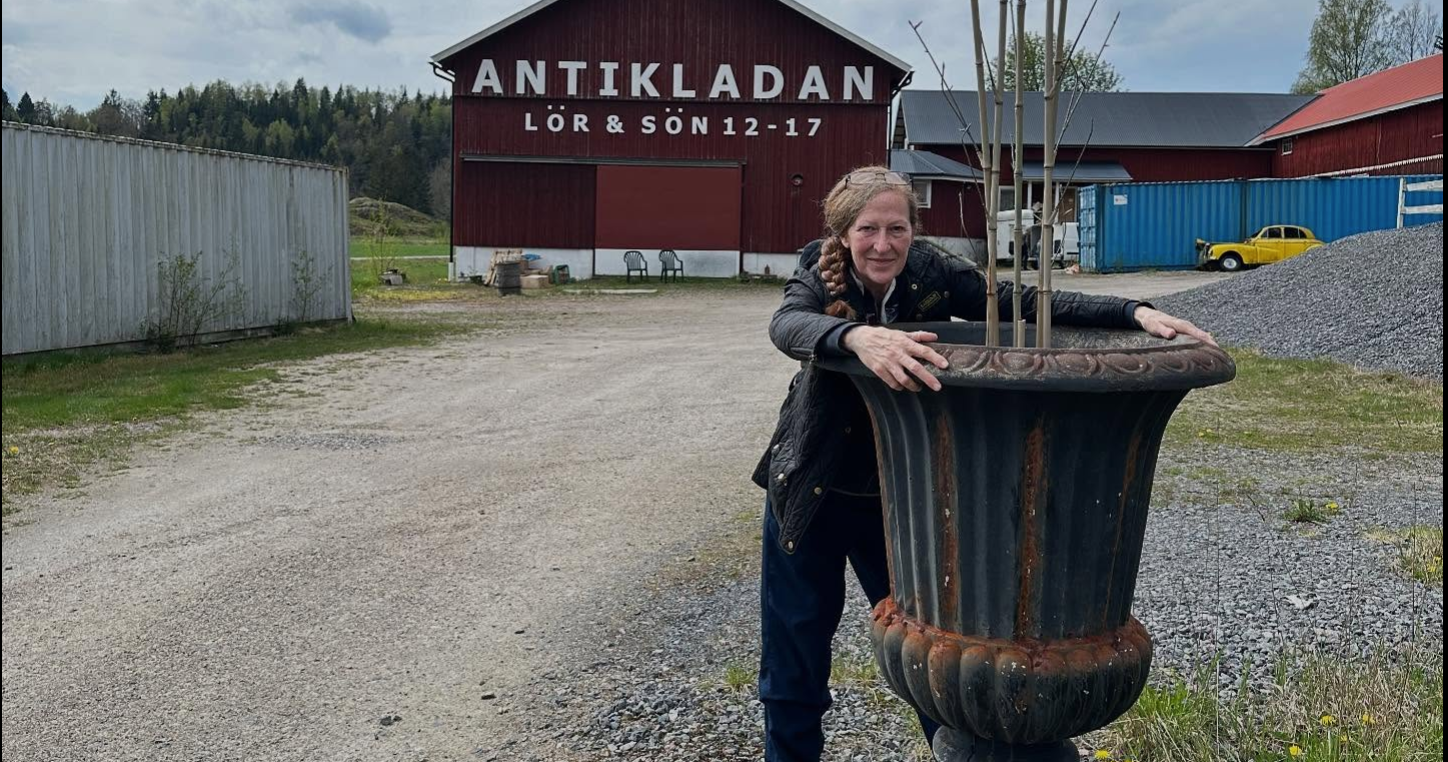
This week’s vintage discoveries in Sweden take us from Bali to India, China and back to Swedish design. I found an extraordinary carved Barong mask, an Anglo-Indian table, a mysterious antique scale, a tiny Lisa Larson mouse and a wonderfully worn copper ewer.
Five very different objects, but each one had a story that made me stop and look a little closer.
Thrifting Drama: Hand-Carved Balinese Barong Mask
There was absolutely no chance I was leaving this face behind.
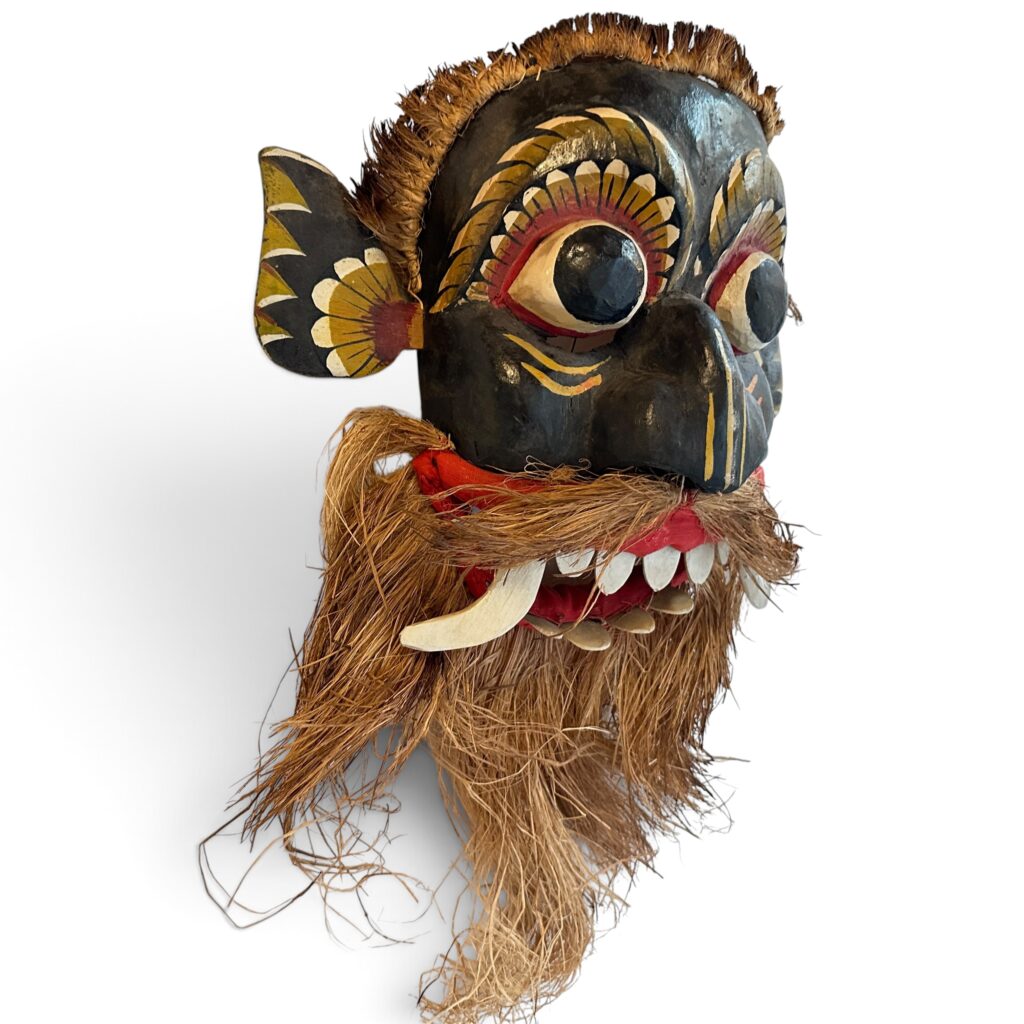
This wonderfully expressive Indonesian mask takes its inspiration from Barong, one of the best-known figures in Balinese tradition.
With enormous protruding eyes, curved tusks, individually formed wooden teeth and a magnificent tangle of coarse fibre hair, subtle it most certainly isn’t.
But behind that extraordinary appearance lies a much older story.
The Story Behind Barong
In Balinese tradition, Barong is a protective figure associated with good and spiritual balance. He famously appears in performances alongside Rangda, a powerful figure associated with destructive forces.
Their story isn’t simply about good permanently defeating evil. Instead, their opposition reflects the continuing balance between competing forces.
This vintage 20th-century example appears to be a decorative interpretation rather than a ceremonial mask. Even so, the traditional imagery is unmistakable.
Someone carved the face from wood and painted it by hand in black, red, yellow and cream. Separate ears, textile, wire and natural plant fibres create the rest of the character.
Turn it over and you can still see the rustic construction. I always enjoy details like this because they reveal how somebody actually built the piece.
And then there are those teeth.
Every time I look at him, I find something else to enjoy. The bulging eyes. The moustache. The tusks. That slightly alarming grin.
Vintage interiors don’t always need to be tasteful and restrained. Sometimes they need something hanging on the wall that looks as though it might start a conversation before you do.
Definitely the find with the biggest personality this week.
My Favourite Find: A Rosewood Anglo-Indian Carved Table
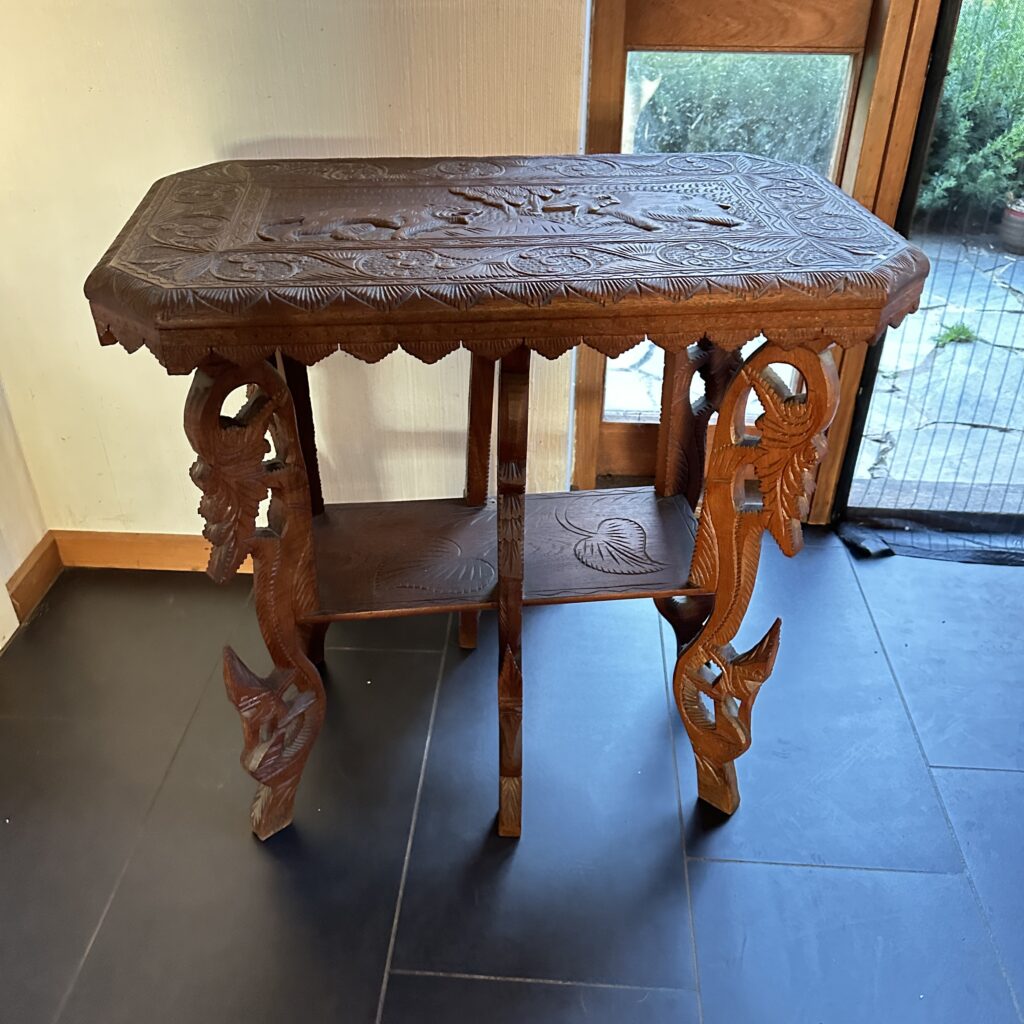
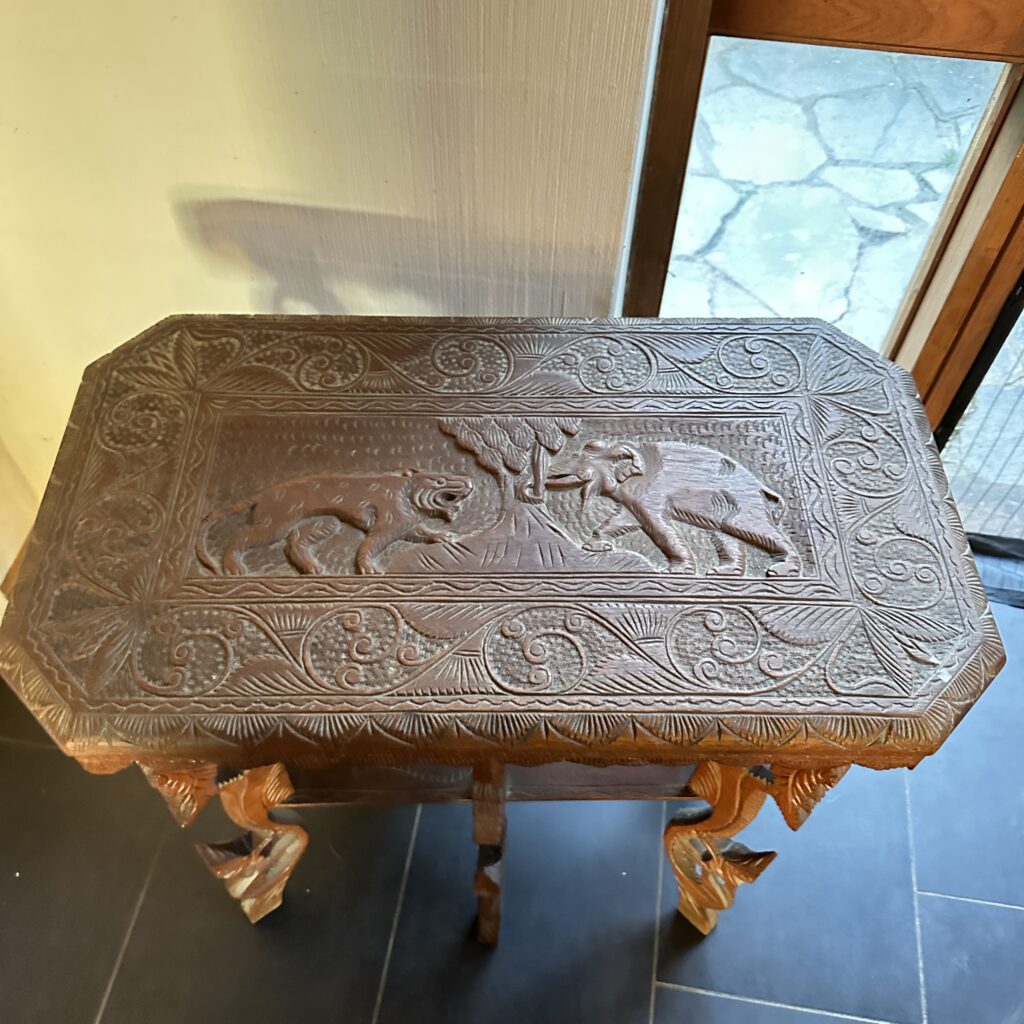
My favourite find this week has to be this extraordinary Anglo-Indian carved table. It is one of those pieces that makes you stop for a second because there is almost nowhere for the eye to rest.
The rectangular top is deeply carved with an elephant and tiger scene, surrounded by scrolling foliage and intricate geometric borders. Then you look underneath and discover even more: pierced carving, elaborate supports, decorative edges and a lower shelf, all worked into the same wonderfully theatrical design.
Likely dating from the early 20th century and made in India from a rich dark hardwood, possibly rosewood, it belongs to a tradition of Anglo-Indian furniture made by highly skilled Indian craftsmen for both local and European markets. These pieces often combined European furniture forms with Indian carving techniques and decorative imagery.
What I particularly love is that it hasn’t been designed to quietly disappear into a room. It is gloriously decorative. The animals, foliage and almost architectural construction turn a practical little table into something much closer to a piece of sculpture.
And that is exactly the sort of vintage furniture I find difficult to walk past.
My favourite detail? The elephant and tiger carving across the top. You could own this table for years and still find another little carved detail you hadn’t noticed before.
Definitely my Find of the Week.

Something Unexpected: A box with a mystery
This was definitely my unexpected find of the week.
When I first spotted it, I thought I was buying a beautifully carved wooden box. I loved the unusual shape, dark timber and deeply carved decoration across the swivelling top. I had no idea what it was, but it was interesting enough to come home with me.
Then I opened it.
Hidden inside was a tiny balance scale, complete with its metal weighing pan, cords and slender beam. What I’d found was what is commonly known today as an opium scale.
These small portable scales were used across China and other parts of Asia for weighing tiny quantities of valuable materials. They weren’t exclusively for opium and could also be used for medicines, herbs, precious metals and gems. Their compact wooden cases made them particularly practical for merchants because the delicate components could be packed away and carried safely.
This example appears to belong to the late 19th or very early 20th century, putting it firmly into what I can’t help thinking of as Sherlock Holmes times. Comparable surviving scales in museum collections date from around 1850 through to the early decades of the 1900s.
And that period gives the object another layer of context. Opium had been used medicinally in China for centuries and recreational smoking was well established by the 19th century. By then it had also become entangled with international trade, colonialism and the enormous profits generated by the opium trade. Small precision scales became part of that world, used to weigh a substance that was both valuable and potent.
But my favourite part of the discovery came afterwards.
Once I knew what I had, I looked at the box again with completely different eyes.
The carving appears to depict poppy seed heads.
Suddenly the decoration wasn’t simply decoration. The clues to the object’s purpose had apparently been carved into the lid all along. I just hadn’t known how to read them.
And yes, this really was the era of Sherlock Holmes. Arthur Conan Doyle was writing Holmes at precisely this time, and Victorian attitudes towards drugs were very different from ours today. The Sign of the Four, published in 1890, famously opens with Watson confronting Holmes over his drug use.
That is what I love about finding old things. Occasionally you don’t just discover what an object is. You discover the world it once belonged to.

A Piece of Swedish History: Lisa Larson Menageri Mouse
Some names become so closely connected with a country’s design history that the objects themselves become cultural markers. In Sweden, Lisa Larson is one of those names.
Larson joined the Gustavsberg porcelain factory in 1954, where she worked alongside some of the leading figures in Swedish ceramics. Over the following decades she developed the wonderfully distinctive sculptural language for which she became famous: rounded forms, expressive faces, animals with almost human personalities and an underlying sense of humour.
This little mouse dates from 1965 and belongs to her Menageri series, a group of five stylised animals created for Gustavsberg during one of the most important periods of her career.
And calling it a mouse almost seems inadequate.
With its enormous ears, rounded body and wonderfully solemn little face, it feels more like a creature from Lisa Larson’s imagination than an attempt to reproduce an actual animal. That was part of her brilliance. Her animals have character rather than simply anatomy.
The Menageri mouse has subsequently become one of Larson’s most sought-after small animal designs, and it isn’t difficult to understand why. At only 12.5 cm tall, it manages to have an extraordinary amount of presence.
Lisa Larson continued designing long after leaving Gustavsberg in 1980, and her work eventually reached audiences far beyond Sweden, particularly in Japan, where her ceramics became enormously popular. By the time of her death in 2024 at the age of 92, she had become one of the most internationally recognised names in Swedish ceramic design.
So this week’s final find may be small, but it represents something much bigger: the playful, warm and slightly eccentric side of Swedish mid-century design.
And perhaps that is why, nearly sixty years after it was made, this peculiar little mouse still makes people smile.
A small piece of Swedish history, with very large ears.
Hidden History: Hidden History in Copper
Some finds shout their history at you. Others carry it quietly in every dent, seam and worn surface.
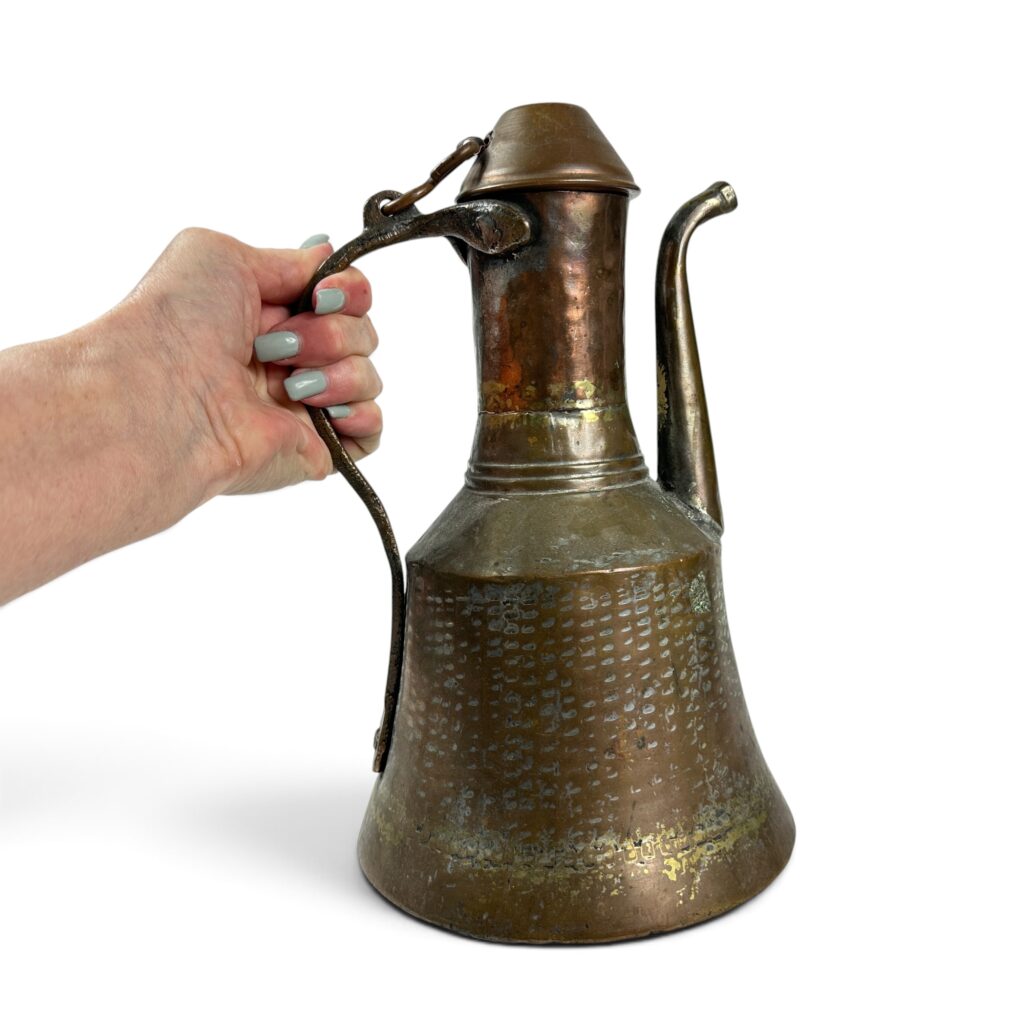
This substantial old copper ewer is one of those pieces. Probably made in Turkey or elsewhere within the Ottoman metalworking tradition around 1880–1920, it was created as a practical water vessel rather than as decoration.
Its form is wonderfully distinctive: a broad tapered body, tall neck, long rising spout and heavy strap handle. The body was shaped and hammered by hand, with traditional seams, soldered joins and riveted construction still clearly visible. Even the simple conical lid survives, attached to the handle by a chain so that it couldn’t easily be lost.
But the real history is written across its surface.
The interior was originally tinned, an important feature of traditional copper vessels. Copper was valued because it was workable, durable and conducted heat exceptionally well, but vessels intended for food and drink were commonly coated internally with tin to create a protective barrier. Over decades of use that lining could wear away and be renewed by a specialist tinsmith.
On this ewer, remnants of that old tinning survive alongside exposed copper, oxidation, darkened areas and countless little signs of handling. It has almost become a record of its own working life.
At 31 cm tall, this wasn’t a tiny ornamental souvenir. It was a useful household object, made to pour, carry and serve.
And that is why I chose it for Hidden History this week. Today we can admire it as a beautiful piece of sculptural copperware, but more than a century ago someone simply reached for it because they needed water.
Sometimes the most ordinary objects leave behind the richest stories
Thank you for joining me on this week’s treasure hunt.
Every Friday, I’ll be sharing five new discoveries, unexpected stories, and forgotten pieces of history uncovered during my adventures through Sweden’s auctions, estate sales, and loppisar.
I hope you’ll visit again next Friday to see what treasures and stories I’ve uncovered.
Amanda.