This week’s vintage finds in Sweden are a wonderfully mixed bunch, from well-loved Russian Matryoshka dolls and Swedish burl wood to antique copper, vintage Ray-Bans and one particularly peculiar wooden Scotty dog.
Sometimes Pottery Finds You: A Well-Loved Set of Russian Matryoshka Dolls
Sometimes age makes an object more interesting rather than less perfect.
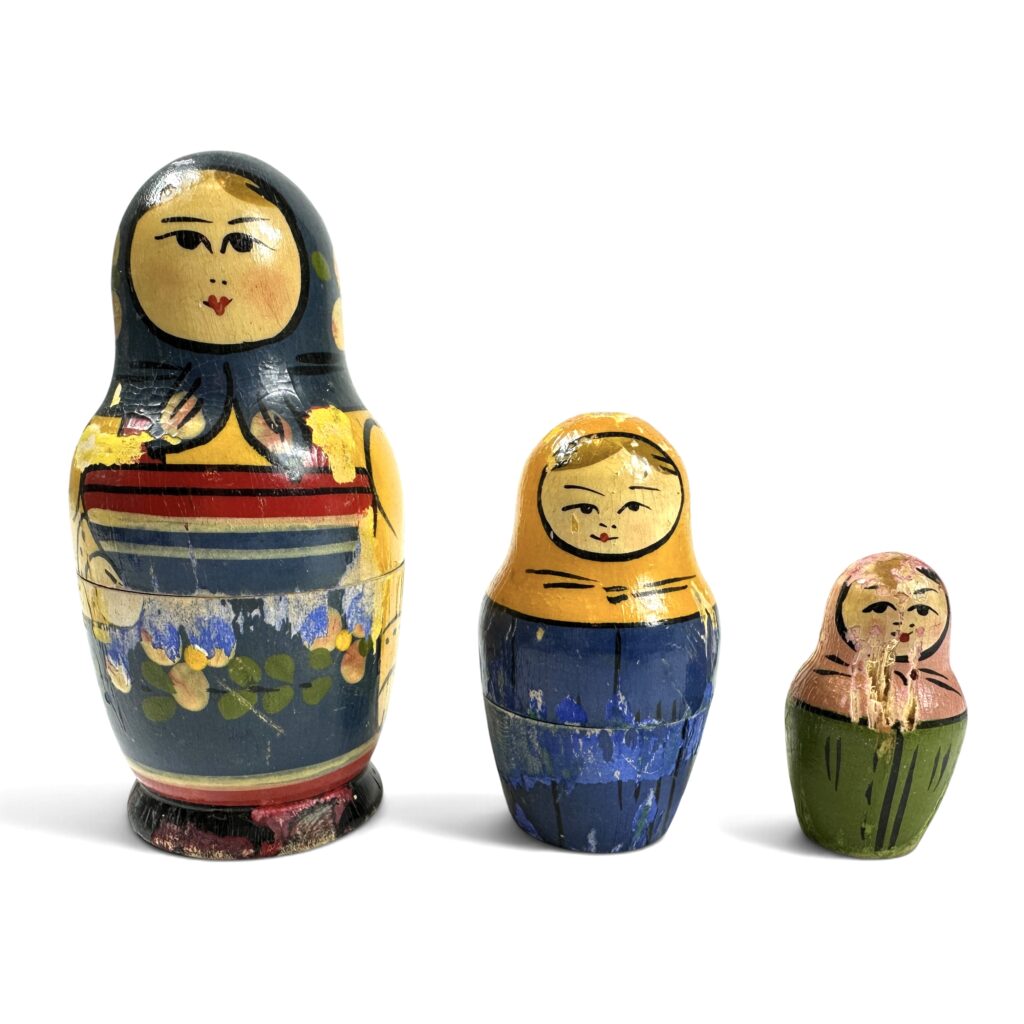
I found this little set of three Russian nesting dolls, or Matryoshka dolls, and their rather battered appearance immediately caught my attention. The paint has worn away in places, the surface is crazed and scratched, and the smallest doll has clearly had a considerably harder life than the largest.
And I rather like them for it.
These are not pristine souvenir dolls brought home from a recent holiday. They appear to have some genuine age, probably dating from around the mid-20th century. All that wear suggests generations of hands have opened, closed, handled and played with them over the years.
The largest doll is particularly lovely, with her dark headscarf, painted flowers and deep blue, red and yellow decoration. Open her up and another appears, followed by the tiny final doll tucked away inside.
A Little Matryoshka History
Russian craftspeople have made Matryoshka dolls since the late 19th century. They traditionally consist of a series of increasingly smaller wooden figures that fit inside one another.
Older hand-painted examples vary enormously in style and quality. Working out where and when somebody made them can become a small research project of its own.
These certainly won’t win any prizes for perfect condition, but that isn’t always what I’m looking for. Sometimes I want an object that has obviously had a life before it reached me.
What to look for: hand-painted decoration, signs of genuine age, the number of dolls remaining in the set, how closely the sections fit together, unusual painting styles and any marks or labels that might reveal their origin.
I paid very little for these three.
And I suspect that somewhere during the last eighty years, somebody loved them considerably more than their paintwork would have preferred.
But to me, that’s part of their charm.
The wear is simply another chapter in their story.
My Favourite Find: A Wooden Scotty Dog With a Secret
Some finds make perfect sense the moment you pick them up. Others leave you wondering, what on earth was this actually for?
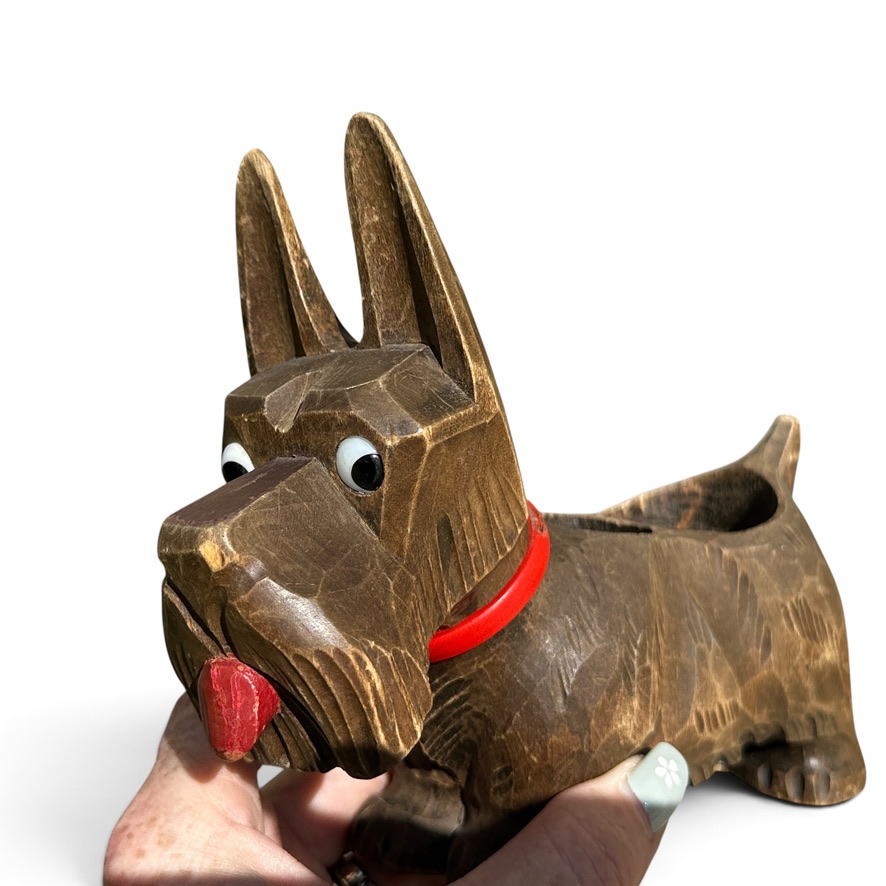
This wonderfully expressive wooden Scotty dog belongs firmly in the second camp.
I spotted him because of that face. Oversized ears, enormous glass eyes, a bright red tongue and an expression somewhere between startled and deeply suspicious.
Then I discovered that his head rotates. With a quick turn, he can look straight ahead, peer sideways or stare accusingly over his own shoulder.
But the real mystery lies in his body.
Two recessed compartments sit in his back. At first they look rather odd, but I think they reveal his original purpose. This little terrier probably started life as a novelty smoking accessory. One compartment could hold cigarettes while the other housed a table lighter.
Somewhere along the way, those fittings disappeared. The wooden terrier survived.
When Smoking Accessories Became Home Decor
People once treated smoking accessories as decorative objects rather than purely practical ones. Manufacturers produced cigarette boxes, dispensers, table lighters and holders in all sorts of imaginative forms.
Animals proved particularly popular. Designers could turn an everyday object into something amusing enough to leave permanently on a desk or side table.
Today, their original purpose has largely disappeared. What remains is a wonderfully peculiar piece of social history.
And I think that’s what I enjoy about him. He comes from a world where somebody apparently decided that a cigarette and lighter holder simply wasn’t complete until it looked like a bewildered Scottish Terrier.
What to look for: unusual compartments or openings that might reveal an object’s original purpose. Check for moving parts, glass eyes, hand-carved details, surviving paint and original fittings. Those peculiar little features often provide the best clues.
His cigarettes and lighter may be long gone.
The attitude, fortunately, remains completely intact. 😂🐾

Something Unexpected: Ray-Ban Wayfarers Charity Shop Find
Sometimes the best vintage finds are the ones you have absolutely no intention of selling.
I spotted these Ray-Ban Wayfarer sunglasses in a local charity shop and couldn’t resist trying them on. That was probably my first mistake. Once they were on, I rather liked them. 😂
They have that unmistakable chunky Wayfarer shape. But it was the unusual pale marbled frames that really caught my eye.
They’re quite different from the classic black Ray-Bans you see everywhere. They’re also considerably more glamorous than my normal treasure-hunting attire. I think they may be staying with me.
Of course, summer in Sweden is rapidly disappearing, so I haven’t exactly timed this discovery well. For now, I’ll tuck them away ready for next year. I shall then undoubtedly forget I own them until approximately August.
Why Vintage Ray-Bans Are Worth Watching For
Ray-Bans are always worth watching for in charity shops and secondhand stores. Collectors often seek vintage and discontinued frames, especially unusual colours and less common versions of familiar designs.
Original markings and model numbers can help identify exactly what you’ve found. The lenses, hinges and case can also provide useful clues.
And that’s part of the fun of secondhand shopping. Not everything has to end up in the shop.
Occasionally you find something that simply makes you think:
No. This one’s mine. 😎
What to look for: Check for clear Ray-Ban markings and model and size numbers inside the arms. Look at the hinges and overall condition. Unusual frame colours, original lenses and surviving cases can make a pair particularly interesting.
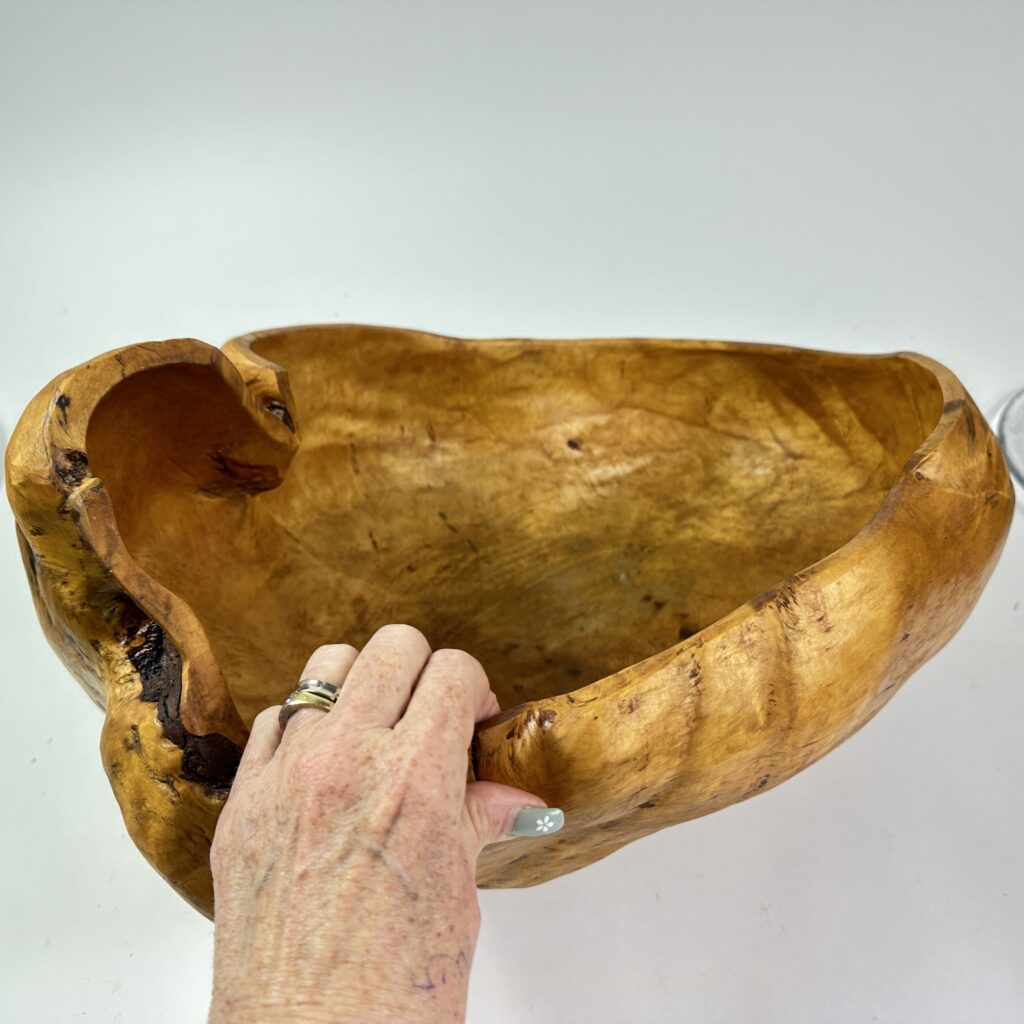
Vintage Finds in Sweden: A Piece of Swedish History
Sometimes the most beautiful pieces of wood are the ones that refused to grow according to the rules.
I found this enormous hand-carved burl wood bowl here in Sweden, and it was impossible to walk past. At almost 50 cm wide and weighing 3.8 kg, it has real presence.
But its extraordinary grain and wonderfully irregular shape caught my attention first.
A burl forms when a tree develops an unusual growth. Inside, the wood creates dense and unpredictable patterns. Once a craftsperson cuts into it, swirling grain, knots and dramatic changes in colour begin to appear.
No two pieces look quite the same.
Burl Wood in Scandinavian Craft
Burl wood has a long tradition in Scandinavian craft. Craftspeople turned these strange growths and irregular pieces of timber into bowls, cups, spoons and other useful household objects.
Instead of forcing the timber into a perfectly regular shape, they often allowed its natural form to influence the finished piece.
And that’s exactly what I love about this bowl.
The maker hasn’t tried to force it into perfect symmetry. Its sides rise and fall with the original timber. Knots and dark inclusions remain visible, while the grain moves through beautiful shades of honey, amber and gold.
You can still feel the tree in it.
The maker probably created it as a practical object. Today, however, it feels almost like a piece of sculpture.
Put something inside it if you like. Personally, I think the wood has quite enough going on all by itself.
What to look for: Look for richly figured swirling grain, natural edges and irregular shapes. Hand-carving, old tool marks and substantial weight can also provide useful clues. The most interesting examples often follow the original growth of the timber rather than fighting against it.
I often talk about preserving signs of age in vintage pieces. With something like this, however, the story began long before anybody carved it.
The craftsman made the bowl. Nature designed the wood. 🌳
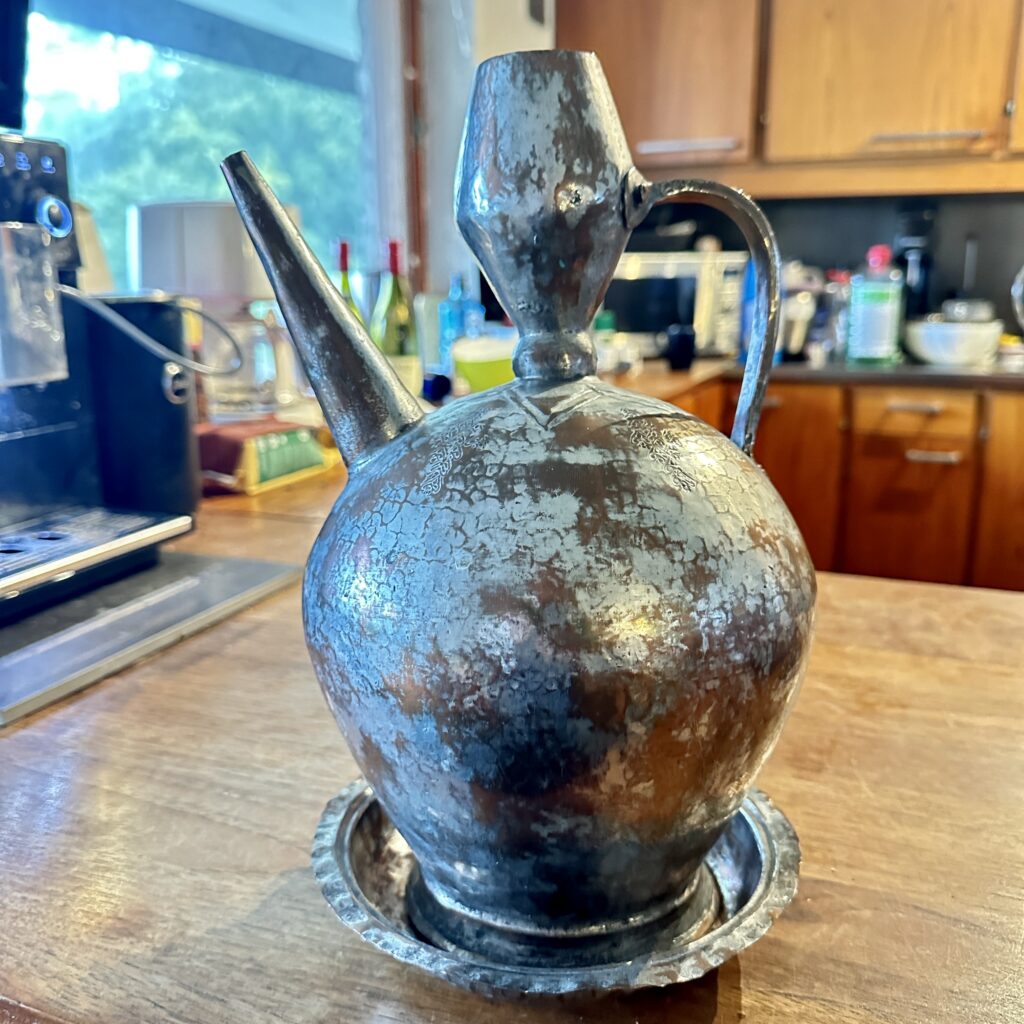
Hidden History: An Antique Copper Ewer Waiting to Be Found
Sometimes the best finds aren’t displayed proudly in the window. They’re sitting quietly in a corner, largely forgotten, waiting for somebody curious enough to take a closer look.
That’s how I found this wonderful old copper ewer and basin in one of my local secondhand shops here in Sweden.
At first it was the extraordinary surface that caught my attention. The ewer was originally tinned, giving the copper a silvery finish, but decades of use have worn through that surface in places to reveal the warm copper underneath. The result is a wonderful patchwork of silver, brown and copper that could never really be recreated artificially.
Then I started looking more closely.
There is a long tapered spout, a hand-worked handle fixed with rivets, a tall filling neck and delicate incised decoration around the shoulder. Even better, the original shallow basin was still with it.
Ewers and basins like these belong to a time before running water was taken for granted. Water could be poured from the vessel over the hands for washing, with the basin beneath catching it. Similar forms have a long history across the Middle East and surrounding regions, although without knowing where this particular example began its life, its exact origin remains part of the mystery.
And perhaps that’s what I enjoy most about finding something like this in Sweden.
How did it get here? Who owned it? Was it brought back from a journey decades ago? And how did something that somebody once took the trouble to make by hand eventually end up sitting unnoticed in a secondhand shop?
We may never know.
What to look for: hand-worked construction, riveted handles, old tinning, engraved or incised decoration, matching components and the wonderfully uneven surfaces that can reveal decades of genuine use.
I certainly wasn’t looking for an antique copper ewer that day.
But fortunately, it had been waiting for me. ❤️
Thank you for joining me on this week’s treasure hunt.
Every Friday, I’ll be sharing five new discoveries, unexpected stories, and forgotten pieces of history uncovered during my adventures through Sweden’s auctions, estate sales, and loppisar.
If you missed last week and would like to see what I uncovered you can follow the treasure hunt HERE
I hope you’ll visit again next Friday to see what treasures and stories I’ve uncovered.
Amanda.